
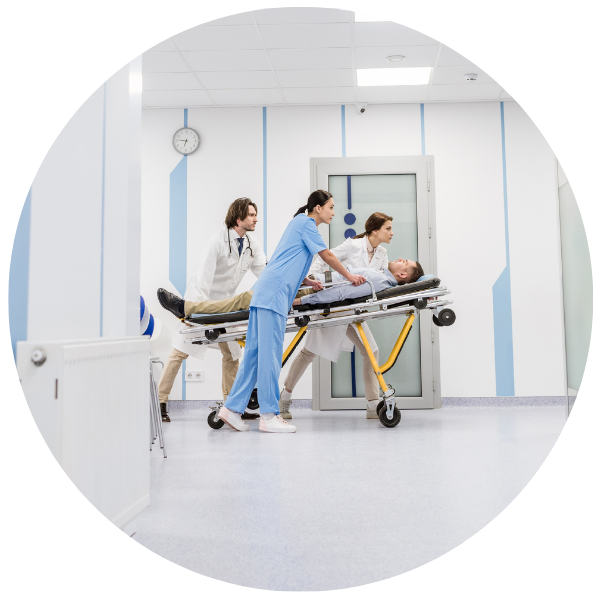
Recent shifts in American healthcare policy have left many Americans without health insurance, creating a ripple effect across hospitals and health systems nationwide. One of the most immediate and visible consequences has been a rise in Emergency Department (ED) utilization, as uninsured patients increasingly turn to the ED as their primary point of access to care. For hospital leaders, this is not as simple as a temporary or seasonal challenge—it is a structural change that demands a more disciplined, operationally mature response.
As ED volumes rise, the organizations that will weather this shift most effectively are those that treat patient flow and operational efficiency as a strategic imperative. In this environment, the ability to move patients safely, predictably, and efficiently from the ED to inpatient care is no longer just an operational concern—it is central to financial performance, staff sustainability, and patient outcomes.
When ED Surges Become the New Normal
Unlike traditional surge scenarios tied to holidays or flu season, today’s ED crowding is increasingly driven by payer mix changes and access barriers across the healthcare system. Higher rates of uninsured patients often correlate with more complex social needs, longer ED stays, and greater challenges in determining appropriate disposition—all of which intensify pressure on inpatient capacity.
When ED boarding increases, the downstream effects are significant:
Longer wait times and delayed care
Increased strain on clinical staff
Reduced inpatient throughput
Lost capacity for higher-acuity or elective cases
To thrive, hospitals cannot rely on reactive, short-term fixes. Sustained operational performance requires a proactive, system-wide approach to managing demand and capacity.
Strengthening ED-to-Inpatient Transitions to Protect Throughput
One of the most critical leverage points in managing ED congestion is the transition from the ED to an inpatient bed. Breakdowns at this handoff quickly cascade into system-wide inefficiencies. High-performing organizations focus on a small number of core disciplines that keep patient flow moving, even under sustained pressure.
Proactive identification of likely admissions is essential. When hospitals use predictive indicators and early clinical signals to anticipate admissions, they can begin aligning inpatient capacity before an order is placed. This reduces avoidable delays and shortens ED boarding time.
Clear ownership of patient transitions also matters. During periods of elevated volume, ambiguity around who is responsible for bed coordination, patient movement, and escalation leads to missed opportunities and delayed decisions. Dedicated transition oversight—whether through defined roles, teams, or structured workflows—helps maintain momentum when volumes spike.
Staffing models must align with demand, not averages. Many organizations still staff to historical norms rather than anticipated variability. Leveraging operational and volume trends to anticipate peak periods allows leaders to align staffing across the ED and inpatient units, reducing friction and burnout during surges.
Eliminating Internal Friction Before It Becomes a Crisis
Even well-designed surge protocols will fail if underlying operational inefficiencies remain unaddressed. During periods of sustained ED crowding, small breakdowns quickly compound into major capacity constraints.
Common friction points include delayed discharges that hold inpatient beds unnecessarily, inconsistent bed turnover processes, and fragmented communication between clinical and administrative teams. When these issues persist, ED congestion is not a demand problem—it is a flow problem.
Hospital executives should view these inefficiencies as leading indicators of risk. Addressing them requires more than policy changes; it requires visibility into how work actually happens across units and disciplines, and accountability for removing barriers to progression.
Why Traditional Systems Fall Short in Today’s Environment
Most hospitals rely heavily on their Electronic Health Record (EHR) to support patient flow. While EHRs are essential for documentation and clinical communication, they are not designed to function as operational command centers. They tend to reflect what has already happened, rather than what is happening or is about to happen.
In a landscape defined by shifts in volume and payer mix, retrospective insight is not enough. Leaders need forward-looking visibility into where bottlenecks are forming, which patients are at risk of delay, and how today’s decisions will impact tomorrow’s capacity.
Without this level of insight, organizations are left reacting to ED crowding after it has already reached a critical point.
Operational Efficiency as a Strategic Imperative
Navigating today’s surge environment requires treating operational efficiency as a core leadership responsibility, not only a departmental initiative. High-performing hospitals focus on designing care progression intentionally—aligning people, processes, and technology around predictable patient movement.
This includes:
Designing workflows that support early discharge planning and reliable bed availability
Establishing clear escalation pathways when barriers emerge
Using real-time operational insights to guide decision-making at the unit and enterprise level
When operational design is intentional and consistently executed, organizations create capacity without adding beds—protecting margins while improving patient and staff experience.
How Care Logistics Helps Hospitals Prepare for What’s Next
Care Logistics partners with hospitals to address these challenges by strengthening the operational backbone that supports patient flow. Our approach is designed to complement—not replace—existing systems by adding real-time operational insight and disciplined care progression practices.
Through solutions like CareEdge by Care Logistics, hospitals gain predictive visibility into patient flow challenges before they impact capacity, enabling leaders to act earlier and more decisively. In parallel, our Operational Model optimizes your people and processes to hardwire success across the entire organization, not just the ED.
By combining technology with operational expertise, Care Logistics helps hospitals move from reactive surge management to sustained operational readiness—ensuring they are equipped to handle today’s ED pressures and whatever comes next.